Why Is Your Hand Grinder Inconsistent? The 7 Most Common Problems & Solutions
Daniel
Author
Published
5 min read
Read Time
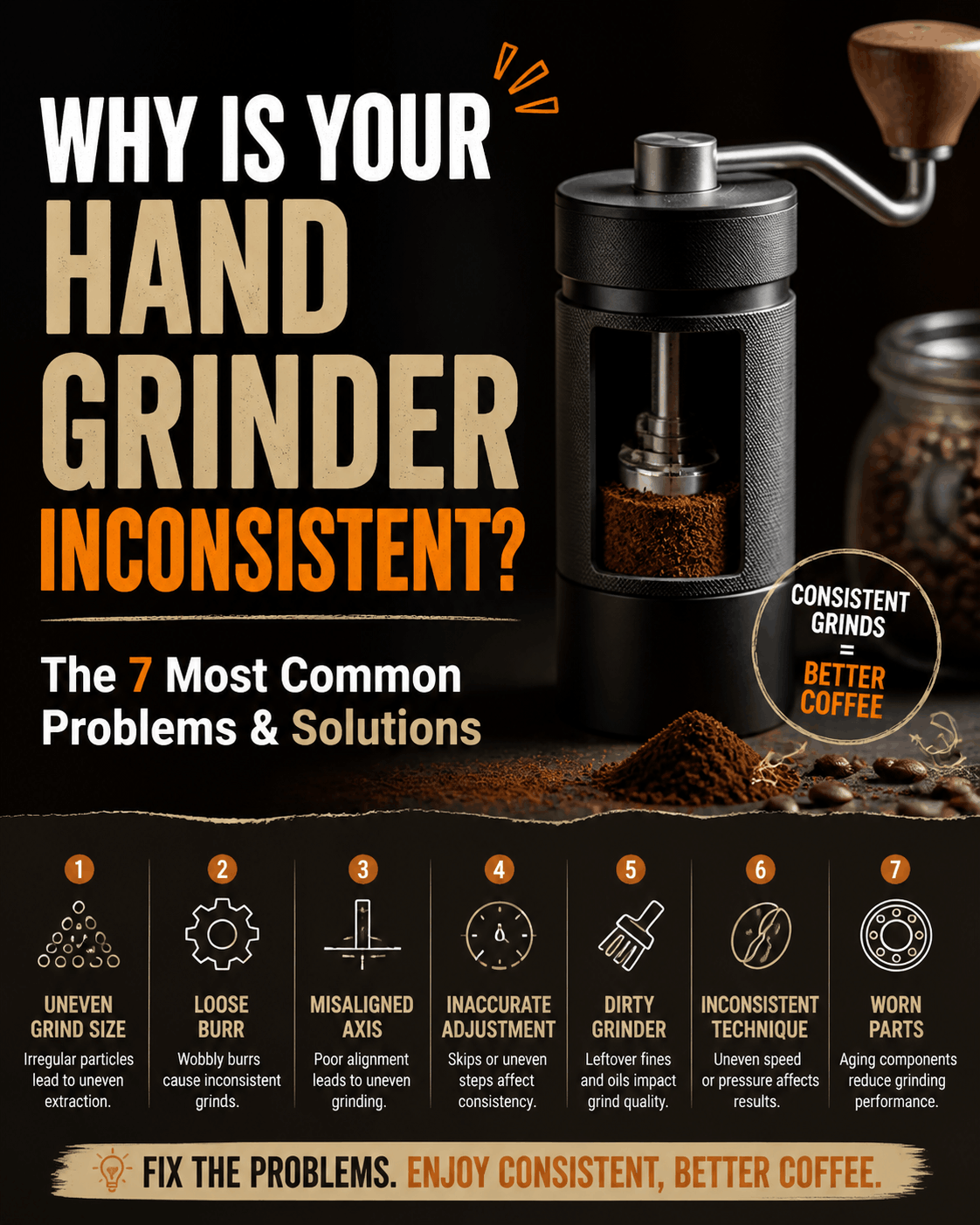
The Grind Consistency Problem
Inconsistent grind size is the enemy of great coffee. Whether you're brewing espresso or pour-over, uneven particles lead to over-extraction (bitterness) or under-extraction (sourness). Understanding why your grinder produces inconsistent results is the first step to fixing it.
Problem #1: Cheap Burrs
Low-quality burrs are the most common cause of inconsistent grinding. Cheap steel burrs dull quickly and may have manufacturing defects that create uneven cutting edges.
"My \$25 grinder came with awful burrs. After two months, I was getting everything from powder to chunky rocks. The coffee tasted muddy regardless of my technique." — Reddit user u/budgetbarista
Invest in a grinder with quality steel or ceramic burrs. Look for models from established brands like 1Zpresso, Timemore, or Kinu. The burrs are the heart of your grinder—spending more here pays off in cup quality.
Problem #2: Single Bearing Wobble
Many affordable hand grinders use a single bearing design, which can cause the inner burr carrier to wobble during grinding. This movement creates inconsistent particle sizes.
"I noticed my grounds had this weird pattern—some super fine, some chunky. Took apart my grinder and found the bearing was loose. The whole assembly wobbled when I applied pressure." — Reddit user u/grinderguru
Look for grinders with dual-bearing systems or solid axle designs. Models like the 1Zpresso JX-Pro and Kinu M47 feature precision bearings that minimize wobble. If your grinder has a loose bearing, contact the manufacturer for replacement parts.
Problem #3: User Technique Issues
Even the best grinder can produce inconsistent results if used incorrectly. Inconsistent rpm, uneven pressure, and shaking all affect particle uniformity.
"I was grinding too fast, trying to get it over with. My grounds were all over the place. Once I slowed down and focused on consistent rotation, everything improved." — Reddit user u/patienceiscoffee
Maintain a steady, consistent grinding pace—aim for 2-3 rotations per second. Apply even, downward pressure without rushing. Let the burrs do the work rather than forcing them.
Problem #4: Grinding Too Slowly
While rushing is bad, grinding too slowly can also cause problems. Extended grinding time generates heat, which can affect both the 咖啡豆 (coffee beans) and your grounds.
"I'd take forever, trying to be 'gentle' with my grinder. Turns out that created more fines because the beans were being crushed rather than cut." — Reddit user u/slowbutsteady
Find your grinder's "sweet spot" pace. You want to grind efficiently enough to cut the beans cleanly, but not so fast that you lose control. Most users find 15-30 seconds for a double espresso dose is optimal.
Problem #5: Dropping and Impact Damage
Hand grinders are precision instruments. A single drop can misalign burrs, damage bearings, or crack internal components—any of which causes inconsistency.
"I dropped my grinder once on the kitchen tile. Didn't think much of it at the time, but afterward my espresso was never the same. The consistency was gone." — Reddit user u/clumsybarista
Always store your grinder in a safe, stable location. Use a grinder stand or protective case. If you suspect impact damage, have your grinder professionally inspected or serviced.
Problem #6: Ceramic Burr Wear
While ceramic burrs stay sharper longer than steel, they can chip, crack, or become worn over time, leading to inconsistent cuts.
"My ceramic burr grinder started producing more fines after about a year of daily use. Inspecting them under a loupe, I could see micro-chips on the edges." — Reddit user u/ceramiclover
Inspect your burrs periodically for chips, cracks, or dulling. Replace ceramic burrs when you notice degraded performance. Unlike steel, ceramic cannot be sharpened—you'll need a full burr replacement.
Problem #7: Hand Grinders Aren't Ideal for Espresso
Here's an uncomfortable truth: even the best hand grinders struggle to produce the ultra-fine, consistent grounds that espresso requires. The physical limitations of manual grinding make espresso-quality extraction challenging.
"I tried for years to get consistent espresso from hand grinders. The best I could achieve was 'acceptable.' Switching to an electric espresso grinder changed everything." — Reddit user u/espressorealist
Accept that hand grinders excel at pour-over, drip, French press, and AeroPress. For true espresso consistency, consider: (1) using a high-end hand grinder specifically designed for espresso like the 1Zpresso JX-Pro, or (2) investing in a quality electric espresso grinder. Your palate will thank you.
Burr Wear: When to Replace
Knowing when your burrs need replacement is crucial for maintaining consistency. Here's a quick reference guide:
Steel burrs can sometimes be sharpened (re-sharpened), but this requires professional equipment. Most users find it more cost-effective to simply replace the burrs when worn.
🎯 Conclusion
Inconsistent grinding usually stems from one of these seven issues. By identifying the root cause—cheap components, technique, or simple wear—you can take targeted action to restore your grinder's performance. Remember: great coffee starts with consistent grounds.
Written By
Daniel
Obsessed with the perfect grind size and water temperature. Sharing the journey of artisan coffee brewing.
More to Explore
Continue your journey into the world of coffee.

Outdoor Coffee is the Best Coffee – Who Else Agrees?
## What Makes Outdoor Coffee Different? Real talk – I've had countless cups of specialty coffee in...
Espresso Tamping Guide: Complete Tutorial for Beginners
Why Tamping Matters Tamping is the bridge between grinding and extraction. It’s the diff...

Hand Grinder vs Electric Grinder Real Comparison for Coffee Lovers
Hand Grinder vs Electric Grinder Real Comparison for Coffee Lovers Stuck betwe...